

 Pay Fees Online
 Order Food Online
 Student Login
 Enquire now
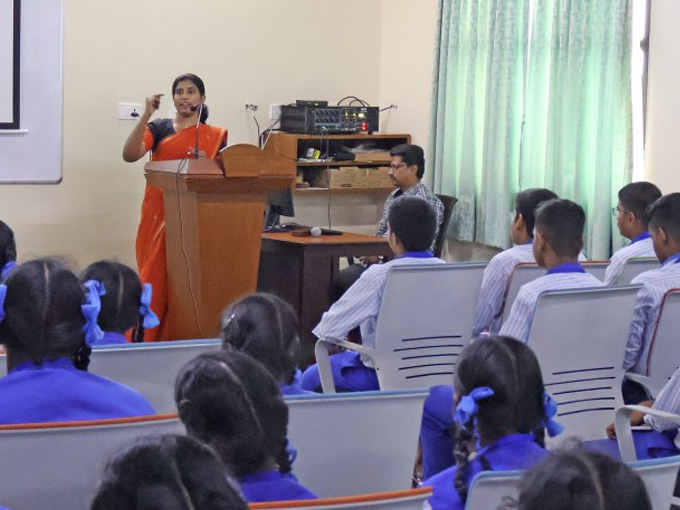
Education is not just about completing chapters, memorising answers or preparing for examinations. Meaningful learning happens when students understand why something works, connect ideas across subjects and apply what they have learned to situations beyond the classroom.
This is one of the important aims of the CBSE curriculum. Along with subject knowledge, it encourages conceptual clarity, competency development, experiential learning and the practical application of knowledge. The focus is not simply on what students remember, but also on what they understand and can demonstrate.
For parents choosing a school, understanding this approach can help them look beyond textbooks and evaluate how their child may develop academic knowledge, practical skills and independent thinking.
What Makes the CBSE Curriculum More Than Textbook Learning?
Textbooks provide the foundation for academic learning. However, students need opportunities to explore, question, discuss and apply the concepts they study.
The CBSE curriculum encourages schools to adopt learner-centred teaching approaches that connect classroom lessons with real-life situations. It promotes experiential and activity-based learning, interdisciplinary connections and competency-based assessment.
For example, when students learn about measurements in Mathematics, they can understand the concept more clearly by measuring objects, comparing dimensions or working with practical examples. Similarly, a Science lesson becomes more meaningful when students can observe a process or understand how it relates to everyday life.
This approach helps students move from memorising information to understanding how knowledge can be used.
1. Conceptual Understanding Instead of Rote Memorisation
Conceptual understanding means knowing the reasoning behind a topic rather than simply remembering its definition or formula.
When students understand a concept, they are better prepared to explain it in their own words, recognise how it works in different situations and use it to solve unfamiliar problems.
For instance:
- Mathematics: Understanding why a formula works instead of memorising it without context.
- Science: Learning the principles behind natural processes through explanations, observation and experiments.
- Social Science: Connecting historical events, geography and civic concepts with society and the world around us.
- Languages: Developing comprehension, communication and expression rather than focusing only on grammar rules.
A concept-focused approach supports stronger foundations because students learn to make connections between ideas.
2. Experiential Learning Through Activities and Exploration
Experiential learning allows students to learn through activities, observation, participation and reflection.
Instead of receiving information passively, students get opportunities to explore a topic and understand it through experience. Depending on the subject and grade, this may include experiments, demonstrations, educational projects, classroom activities and field-based learning.
Some examples include:
- Conducting simple Science experiments to observe cause and effect.
- Using models and visual materials to understand complex concepts.
- Creating charts, presentations or projects to explain a topic.
- Exploring plants, the environment and natural resources through observation.
- Participating in group activities that encourage discussion and shared learning.
Such experiences can make lessons more engaging and help students connect theoretical knowledge with practical situations.
3. Competency-Based Learning Builds Application Skills
Knowing a fact and applying that knowledge are two different abilities.
Competency-based learning focuses on what students can understand, demonstrate and accomplish after learning a topic. It encourages the development of subject knowledge alongside skills such as problem-solving, communication, reasoning and critical thinking.
For example, a student learning percentages may be asked to interpret a discount, compare prices or solve a practical numerical problem. This gives the student an opportunity to use mathematical knowledge in a familiar context.
The CBSE approach encourages learning outcomes and assessments that examine students’ understanding and application, rather than relying only on the reproduction of memorised answers.
4. Interdisciplinary Learning Connects Different Subjects
In everyday life, knowledge is rarely divided into separate subjects. A practical problem may require Mathematics, Science, language skills and logical reasoning at the same time.
Interdisciplinary learning helps students recognise these connections.
For example, a classroom project on water conservation may involve:
- Science: Understanding the water cycle and the importance of conservation.
- Mathematics: Recording and comparing water usage.
- Social Science: Exploring water resources and community responsibilities.
- Language: Preparing a report, poster or presentation.
By connecting subjects, students can develop a broader understanding of a topic and see how different areas of knowledge work together.
5. Smart Classrooms and Learning Resources Support Understanding
Visual and digital resources can help teachers explain topics in different ways. Smart classroom tools, educational videos, diagrams and presentations may make abstract concepts easier to understand when used alongside effective classroom teaching.
At Amalorpavam Lourds Academy, the school’s curriculum information highlights the use of smart classroom educational methodologies and audio-visual learning resources. These resources are intended to support classroom explanations and help students engage with academic concepts.
Technology is most useful when it supports learning objectives, encourages participation and helps students understand the subject more clearly.
6. Practical Learning Develops Curiosity and Problem-Solving
Practical learning gives students opportunities to ask questions, test ideas and explore possible solutions.
A student who observes an experiment, builds a model or works on a project is encouraged to think about the process—not just the final answer.
These activities can help develop:
- Curiosity and a willingness to ask questions.
- Logical reasoning and analytical thinking.
- Creativity and independent problem-solving.
- Collaboration and communication.
- Confidence in explaining ideas and presenting work.
These skills are useful not only for academic progress but also for situations students may encounter outside school.
7. Co-Curricular Activities Contribute to Holistic Development
Learning and development extend beyond academic subjects. Sports, fine arts, cultural activities and other co-curricular opportunities allow students to explore interests and develop different abilities.
Participation in such activities can encourage teamwork, discipline, creativity, communication and physical well-being.
Amalorpavam Lourds Academy highlights sports, fine arts and co-curricular activities as part of its broader educational environment. Its curriculum information also describes opportunities for students to participate in activities beyond classroom learning.
A balanced school experience gives students opportunities to develop academically while exploring their interests and abilities.
How Does Amalorpavam Lourds Academy Support Learner-Centred Education?
Amalorpavam Lourds Academy describes its educational approach as learner-centric, with an emphasis on nurturing students’ knowledge, skills and overall development.
The school’s published curriculum information highlights several elements of its learning environment:
- Learner-centric curriculum: A focus on nurturing students and supporting their academic and personal development.
- Smart classroom methodologies: Audio-visual resources that support the explanation of classroom concepts.
- Play-way learning in Kindergarten: Activities that encourage interaction, imagination and early intellectual development.
- Computer education: Included in the regular syllabus from Standard III, as described on the school’s curriculum page.
- Foreign language learning: French is listed for students from Class VI onwards.
- Sports and fine arts: Opportunities that contribute to physical development, creativity and co-curricular participation.
- Academic enrichment: The school describes preparation opportunities for selected Olympiads and competitive examinations.
Together, these elements reflect the school’s stated focus on academic learning alongside wider student development. Parents can explore the school’s curriculum and facilities to understand the learning opportunities available at each stage.
What Should Parents Look for in a School's Teaching Approach?
When evaluating a school, parents can look beyond the syllabus and ask how classroom learning is experienced by students.
Consider these questions:
- Are students encouraged to ask questions and explain their understanding?
- Are practical activities, demonstrations or projects used to support lessons?
- Do teachers connect academic topics with everyday situations?
- Are students given opportunities to work collaboratively?
- Does the school encourage participation in sports and co-curricular activities?
- Are learning resources used to make difficult concepts easier to understand?
- Does assessment help identify areas where a student needs further support?
These questions can help parents understand whether the school’s educational environment supports meaningful learning and overall development.
Conclusion: Learning That Goes Beyond the Classroom
A strong educational foundation involves more than completing textbooks. Students benefit when they understand concepts, explore ideas, apply knowledge and develop the confidence to think independently.
The CBSE curriculum encourages this broader approach through conceptual learning, experiential activities, competency development and real-world application. When supported by effective teaching, appropriate learning resources and co-curricular opportunities, these approaches can make education more meaningful.
At Amalorpavam Lourds Academy, the learner-centric curriculum and the school’s stated emphasis on academic, practical and co-curricular development provide parents with opportunities to explore an education that looks beyond textbook learning.
Explore the Amalorpavam Lourds Academy curriculum to learn more about its educational approach and learning environment.
Frequently Asked Questions
The CBSE curriculum aims to provide structured subject knowledge while supporting conceptual understanding, competency development and holistic growth. It encourages teaching approaches that help students understand ideas, apply knowledge and develop skills such as critical thinking and problem-solving.
CBSE encourages experiential learning, classroom activities, projects, interdisciplinary connections and competency-based teaching. These approaches give students opportunities to explore concepts, participate actively and connect academic knowledge with real-life situations.
Experiential learning is an approach in which students learn through activities, observation, experiments, projects and reflection. It helps them understand concepts by participating in learning experiences rather than relying only on explanations or memorisation.
Competency-based learning focuses on students demonstrating what they know, understand and can do. It encourages the application of knowledge, reasoning and problem-solving through learning activities and assessments.
Practical learning can help students connect theory with real-life situations. Through experiments, projects and activities, they can develop curiosity, analytical thinking, creativity, collaboration and confidence in applying what they learn.
The CBSE educational framework supports holistic development, including physical, intellectual and social development. Schools provide co-curricular opportunities such as sports, arts and other activities as part of their educational environment.
Conceptual learning helps children understand the reasoning behind what they study. It can support better application of knowledge, independent thinking and problem-solving. Parents can look for schools that encourage questions, practical activities and meaningful classroom participation.
 Mandatory Public Disclosure